When that box fell off the corner of my hand truck and spilled things
all over the floor I thought I’d die.
How I hate this job! No one heard
the crash, thank God. I love art, but I hate this job. Every day I think
about that museum guy in Oslo who said, ‘Bill, if you love art, stay out
of museum work.’ I should have listened to him. But I do love art, and
where else can you get so much of it?
I’m addicted to art. Art and games. But even the most outrageous art
and the most extreme games didn’t prepare me for what happened the next
few seconds after that so-called artwork fell off my hand truck, fell flat
on its side, and its plastic see-through cover popped off the top. A
huge—I mean big as my thumb—black spider went running out!
I panic’d. On top of the thrill of seeing that thing go over, and
all the noise, and this huge black widow as big as a marble go skittering
out, it was too much. My natural urge was to smash the spider. I knew
without looking at her underside for the red hourglass that it was a black
widow. I grew up in Eastern Washington State and I knew those things.
Then it happened. Just as I was about to squash her, she screamed! I
froze, foot in mid-air. I almost lost my balance. She screamed again. I
wasn’t just hearing things; maybe it’s because I wear these digital
hearing aids and the frequency was just right—but I know she screamed.
She stopped, too and then the most amazing thing happened: She spoke!
I don’t know what I did next, exactly. I felt like I was in some
kind of science fiction movie or caught on a bit on candid camera. Good
thing I have a sense of humor. Good thing I live on art and computer
games. Because if I didn’t believe such things were possible, I’d just
have smashed the spider and gotten back to my boring job—which was, now,
made all the worse by the mess I’d have to clean up, putting this thing
back together and hope no one knew the difference.
I could lose my job. Maybe I’m losing my mind. Whatever the case may
be, I think what I’m going to tell is worthwhile. Or, I should say, what
she told me is worthwhile because the spider turned out to know a
lot more about that thing—that artwork—than anyone ever could have
known if she hadn’t told me.
I wish I could tell you about what she was like, the spider’s voice
and—you won’t believe this—her charm. Call it spider charisma
if you want to because that’s what I think it was like. It was like
listening to a very experienced storyteller or a seasoned actor reading a
novel on a tape. Her voice was tiny, but I could hear her just fine.
I think it was quiet for quite a while—the two of us just poised; I
with my foot in the air, and the spider cowering underneath. I could hear
the fluorescent lights of the museum storeroom buzzing softly overhead.
Then she spoke:
“Thank you for not killing me,” she said. “I’m a spider, put
under a spell by a wicked scientist doing genetic research. If you don’t
kill me, I’ll give you something that will make you happy.”
It was quiet after that because I didn’t know whether to say
something or not, I was so stunned by what was happening. Talk to a
spider? A black widow, whose bite could very well kill a guy my age?”
She spoke again.
“I realize it’s weird to talk to me, but say something. Or, let me
be on my way. I’ll just find my way into some dark place where I won’t
bother anyone. Live out my days, if that’s all right with you.”
Cautiously, she began to walk toward a crack under a storage cabinet door.
“No, wait,” I said. My voice sounded thunderous compared to hers.
I softened. “No, wait. Wait a second. I’ll listen. I won’t kill
you.” I actually kept that option open, but she probably didn’t know
that. Or, as I learned later, in her wisdom she probably knew the chances
were pretty good that I might.
She had stopped in her tracks and did a funny thing I guess you could
call sitting down, in a way a spider might. “Okay,” she said, and I
think she may have sighed. “I am so glad to get out of that box! If you
hadn’t tipped it over, I probably would spend the rest of my life alone
in there with nothing to do. Tell me, what is this place?”
Now I was really baffled. Explain an art museum storage basement to a
black widow spider? My mind wouldn’t give me a clue. I simply said,
“You’re in an art museum.”
What an amazing thing she did then! She hopped! “An art museum! Oh
joy!” She hopped again, sideways.
“Joy?” I said, dumbfounded.
“Yes! Oh, now I believe I’m truly charmed. I lead a charmed life,
that’s all you can say. I’ve been living in an artwork for I don’t
know how long and now it turns out I’m actually in an entire museum of
art!”
“That may be good news to you, but I can think of better places to
be. You, for example, could be in a barn on a farm instead of here,” I
said.
“Speak for yourself,” she said with a level voice, “I’d rather
be in an art museum than on a farm. I’ll tell you, I was running out of
things in that box. Now I have a whole museum to explore. I truly am a
charmed spider.”
Now I have to say I was actually starting to enjoy this experience.
Maybe I’d actually fallen and hit my head, and this was a dream. Anyway,
there was something about this spider that was charming. There’s no
other way to put it. But I had to remember: Get too close and it could be
curtains. I’d really be in a dream—for eternity!
She was a charmer.
I could have listened to her stories for hours, but I saw it was getting
close to quitting time. In less than 30 minutes security would be coming
through.
I said, "I
hate to interrupt, but I've got to reassemble this stuff and lock it
up." I explained the situation. I told her, “You'd better find a
place to hide; the security people don't wear hypersensitive hearing aids
and they wouldn't be happy if they spotted you." She started to crawl
away.
Then,
"Wait," said the spider, stopping. She came a few inches toward
me. "I'll make you a deal. You seem like one of the good ones. Tell
me what you're supposed to do with that stuff you’re calling art and
I'll see if I can make your job easier." She sat still then and I
surveyed the scattered parts on the floor.
The acrylic box that had been
her prison lay on its side. A wooden box holding a black telephone was
next to it, and alongside it a gray oblong, squarish thing that looked
like a small graveyard headstone. The wooden box had contained, along with
the black telephone, about a hundred little rocks, bits of flint, Indian
arrow points, carved bone and odd things - junk -like you’d see in someone's
souvenir junk box.
She must have been
able to read my mind. She said: "You have to list all that, don't
you?"
"How'd you
know?” I asked. “Yes. That's my job. I'm the assistant curator and my
job is to catalog this - this 'art'."
"Ha ha!"
she laughed. You try to imagine a black widow spider laughing!
"Aren't you in luck!" she said. "I can help you. Oh, I'm
charmed!" she cackled. She explained that in the time she was trapped
- twice, in fact, the first time inside the bottom, under that gray
stone-like thing and later under the acrylic box - in that time she had
studied the contents.
She was unreal. She
had supernatural powers. This was the stuff of supernatural extreme
sci-fi. It seemed to me in the few minutes she described her confinement
and what she learned studying the things in those two boxes that she could
see through everything that art was about.
Fast Forward
-
I woke up in a
hospital.
It turned out I had
been bitten by something, apparently, and the security guard found me unconscious.
I'd been comatose for a while; but in that time I'd talked a lot, rambling on and on, they
said. One of the volunteers became interested in my rambling and she began to take my words down on a pad of paper, making
notes.
Original concept on July 9, 2003 after reading Chuck Martin’s
comment, "An easy way to
build context for interactive content is to think like a [orb web-weaving] spider and build
a web around the core element that motivates the content.": Here’s
what I wrote, inspired by Martin’s suggestion: “Stone Phone and a
spider crawling out of it when the museum curator opens the glass box. The
story that the spider tells unfolds like a biography. She's a genius
spider and has converted the old 'phone into a wireless device that can
download streaming video, and she shows the curator clips from a secret
cache of old videos that make the Miller boys'
game, Myst, look fake!”
|
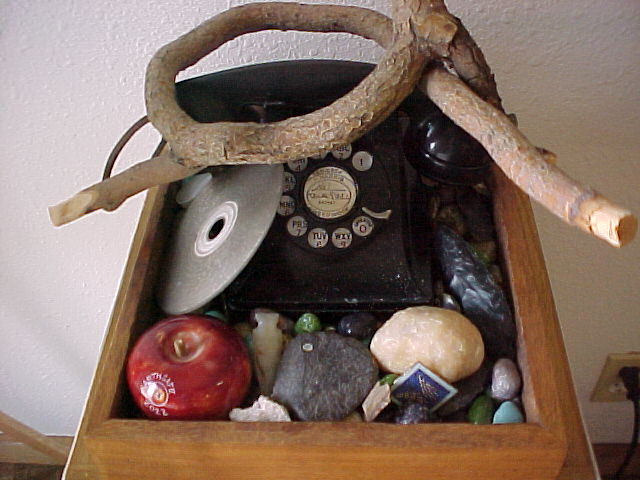
Above: "Stone Phone" is an assemblage or collection of stones, pins, artifacts and other objects clustered around a vintage telephone. Arrowheads-both old and new-figure prominently as symbolic of action at a distance.
Bill
H. Ritchie is a Virtual Itinerate Professor of Art in Seattle. He taught 19
years at the UW as a professor of art, traditional printmaking and media
arts. Resigning at 43 to start his own learning, research and production
company, he created Emeralda in 1992, a game strategy he likens to a
fantasy region accessible only by computer. He invented rules-of-play and
an operating system he wants to be an online interactive game. He’s
immersed himself in a virtual promised land in the age of digital
reproduction.
He writes for the benefits of discipline,
using a PDA when he's wandering around and a desktop PC to organize his
essays. He has a thousand or more saved, which you can see listed on the
ten "islands" on the Web..
For
further information via e-mail: Ritchie@seanet.com.
The company’s name is Emeralda Works, LLC, 500 Aloha #105, Seattle, WA 98109.
Telephone (206) 285-0658. This article’s statistics are: 1782
Words. 7714
Characters. 3
Pages. iri30709
The Widow and Me. ©2003 Bill H Ritchie, Jr.
|