Gajillion Dollar Opportunity:
The Gates Prize Awaits YOU
To an old physics professor, who thinks he knows better, psychology indicates that an inventor’s psychology is not a pretty picture. However, inventors who are artists have an edge, and this edge will make even that physicist’s on-line museum a success—more so it would be an on-line art museum.
Copyright 2003 Bill H. Ritchie
Here's a quote from a columnist on the IGDA Web site under the title, The Future of Games:
"As an art form, immersive games are in a transitional state, currently positioned on the cusp of something almost unrecognizably different. Future games will employ deeper simulation in order to achieve far greater levels of interaction and complexity, while simultaneously simplifying the learning curve for new players.
"Most game environments of the past have been based on crude abstractions of reality, limiting player expression and requiring users to learn a completely new vernacular in order to play. The games of the future will rely heavily on much more complex, high fidelity world representations that will allow for more emergent behavior and unforeseen player interactions.
"Taken together, these next-generation design paradigms are not simply improvements over older models, but represent a fundamentally different approach to simulating real-world physics, handling artificial intelligence and interface usability."
I figure that someone writing with an insider's perspective knows at least a little about what he's saying when it come so games. So I noted his expression, "something almost unrecognizably different" and I thought of my game, Emeralda. I figure I don't have to go buy an armload of yesterday's games, based on those games based on "crude abstractions of reality" (Myst, Magic, Monopoly, Solitaire, etc.) to understand what he's talking about.
I figure I only have to look inside myself to see what the "almost unrecognizably different" games he's talking about are like. Like Dorothy in the Wizard of Oz, clicking the heels of her ruby-red shoes together in order to go home to Kansas, I figure I can just about have my "game of the future" right now, just by clicking my mouse on a few choice software packages and cobbling it together with HTML.
I can role play. I can put myself in the role of an inventor of tomorrow's blockbuster game. Then, my search starts for something to play with, something to shoot (to use one of yesterday's crude abstractions that were the basis of first-person shooter games). I'll switch over to the Web, go to the The Chronicle of Higher Education, and look for an idea.
Aha! A physics professor created an on-line museum of perpetual motion, and the article ended with the sentence, "Inventor's psychology is not pretty." What does he mean? He said they make common mistakes; witness the contents of his museum.
My defenses go up: I want to say, "Professor, I'm an artist, about to paint you a pretty picture - and I might also paint over your museum!" On the sidebar at the right is the professor's article, from the June 27 issue of The Chronicle.
Now, about that Gajillion Dollar Opportunity I promised, what I call the Gates Prize. To win it is simple, really--but not easy. Break into the art professor's memory bank, his "perpetual motion machine of the visual arts" and find out how he or she does it. Get past the "not pretty" parts of technique, politics, moral and ethical issues, money and power, and find the gold.
In other words, put the fine art professor, or artist teacher, on-line, in a form almost unimaginable to us today.
But only almost.
I qualify that unimaginable bit with the word almost because I almost can see it, and with help from some of the other geniuses right around the Puget Sound region, my Emeralda Region--an imaginary place for on-line art gaming--will be realized. Or, should I say, almost realized, because the players--the doers--will be the ones to actually finish the game.
If an on-line, persistent-state game could be created, it could act as its own source of constant energy because the players - in roles ranging all over the art world board - would be adding their input to a great database in the sky.
Serious artists, however, have discredited this mediated learning theory, arguing that it ignores basic rules of hands-on proximity with the artist/teacher.
Maybe they're just too serious! They should, in my humble opinion, lighten up.
Play my game.
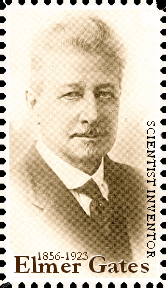
The author made this stamp in honor of Elmer Gatess,
a turn-of-the-century inventor and early neuroscientist. Ritchie invented
a game called Emeralda and needed a goal, so he created the Gates Prize -
akin to the Pulitzer, Nobel or MacArther prizes. This one's for teaching.
Then he needed a personage (besides the obvious Bill and Melinda Gates
Foundation), and Elmer Gates name came up.
Bill H. Ritchie is an Itinerate Professor based in Seattle. He taught college (UW) and after promotion to full professor of printmaking and media arts, he resigned at 43. He then launched several teaching, research and practice companies. In 1992 he discovered Emeralda, a fantasy region accessible only by computer. He invented the rules-of-play and created an operating system for online interactivity for himself.
He writes for the benefit of discipline, using a PDA when he's wandering around and a desktop PC to organize his essays. He has a thousand or more saved, on the island of RIISMA in the Emeralda Region he has a blog under Services.
For further information contact Bill H Ritchie via e-mail at ritchie@seanet.com. His professional Web site is at www.seanet.com/~ritchie. The company name is Emeralda Works, 500 Aloha, Seattle, WA 98109.