I invented a game I call Emeralda:
Games for the Gifts of Life. Actually it’s not a single game, but
rather a collection of games.
I wasn’t always a game inventor. I’ve
been an artist - a printmaker - most of my life. I came to think that
there’s a connection
between printmaking and games.
My game helps me understand things, the things I call my gifts.
Thinking about games is a gift to me. In 1968 I
made an etching called Collection
III: Part of the Children’s Game and for years afterward I wondered
what the word games in the title meant. Even though I created the etching and named it, I
was never sure what it meant.
As I invent the suite of games that go under the umbrella name, Emeralda,
I’m doing several other things. Like someone writing the story of
one’s life while he’s living it, I’m “playing the game as I invent
it.”
This is like a pastime common among children who, alone or with
their others, make up games and stories as they go along. It’s
improvisation. Working alone, kids may invent playmates. I’ve done this
too, populating my imaginary place called Emeralda
Region with muses and “ghosts”.
Along with my daily routine of inventing the moves in Emeralda (I’d
like to patent this routine, called “method of play,” someday, if I
can get it into words), I’m creating the game pieces for one of the
games called Stamps ‘N Stories. This consists of my taking a
digital snapshot of an artwork in my cabinet and converting the image into
a stamp I can then print digitally.
The purpose of the game is, to put it into technical language, Asset Management and Legacy Transfer
or AMLT. (How about “Human
Asset Management & Legacy Electronic Transfer” or HAMLET?). Another
purpose I have in mind for this game is to develop and maintain human
creativity.
Switching from techno-talk to the language of accountants,
Emeralda is a scheme for capturing and profiting from Human
Structural Intellectual Capital, or HSIC. (Apparently, playing Emeralda
has the effect of conjuring new acronyms, too!)
For example, as a creative act in writing, I paused in my Emeralda
play to write the essay you're reading. That was when I had just gone through a process
of using the digital snapshot of one of my prints from 1963 titled Four
Pheasants, for a stamp design. As I went through the steps, I was also
wandering along a parallel question: Would other people, potential
players, be able to do this, too?
And, why
would they want to?
The steps of converting a print to a cinderella stamp consist of changing the digital camera snapshot from a
1-dot-per-inch JPG file (the way it comes on my Sony Mavica camera) to a
300 dpi image, then cropping, tuning the contrast and brightness, and
adding the simulation perforations around the edges. Then I change it to a
TIF file and add the lettering. Last I convert it to a GIF file and this
is the “close-up” view I use in the “stories” section.
Then comes the final step: shrinking the stamp down to a “hot
button” size. There’s more that I do as I go through these steps, such
as storing it in the correct files and making sure I’m using the correct
file types.
All the while, parallel to this, I’m getting flashes of ideas
in my mind as to what else I could do with this game. For example, I
conceived of the yet-nonexistent Pacific Digital Fine
Arts Festival in connection with my art ed on-line campaign.
Forty years in the arts, a span of three generations in my 61 years,
has given me a fertile imagination and many projects I want to complete. I’m aware of the fact that since I
was born in 1941 I’ve lived through three generations that are very
different: the reading generation, the TV generation, and the games
generation. But unlike most people my age, I’ve also had the benefit of
up-close and hands-on acquaintance with the technologies of each
one—text, video and multimedia.
Text Gen
The reading generation (people in their sixties) also knows how to
write.
TV Gen
The TV generation gave me not only a lot of TV viewing time (like
almost everyone else) but also video-making (unlike most people).
Games Gen
The games generation found me living in one of the computer games
hotbeds, a hi-tech center—one of the richest in money and talent in the
entire world.
Talk about human intellectual capital! In this milieu I moved from
text, to video, to hypertext multimedia—the latter that is the stuff
digital games are made of.
It’s in the region where I experienced all this, the Pacific Northwest - blessed by the bounties
that college and college teaching brought me - that I am bringing all three
together: Text, Video, and Games. Emeralda is my imaginary place,
fashioned after the Northwest. It could only happen here.
It’s all taking place concurrently, in
one realm—Emeralda. It’s happening in my imaginary place where
teaching and learning, research, practice and community service go on at
the same time, under one roof. I called it the Perfect Studios
when I first envisioned it.
Finally, I’m arriving at the threshold of a new kind of teaching and
learning called by an author named Marc Prensky (of a book by this name) digital game-based
learning. In a way I’m arriving where
I began my work as an art student and an art professor.
Where I go from here depends, every day, on the game I play, and I play with the faith that the gifts of my life have given to me.
Emeralda is my game for the gifts of life. I'd like to make it so for everyone.
|
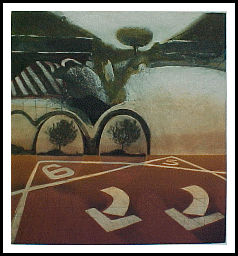

Art Student Reading notes. P. 306.
The author made this intaglio print in 1968 using
traditional engraving and a then-new photo etching technique in
combination. He never knew what the "game" reference meant, nor
what the numbers and arrows meant.
About the author: Bill H. Ritchie is an Itinerate Professor based in Seattle. He taught college (UW) and after promotion to full professor of printmaking and media arts, he resigned at 43. He then launched several teaching, research and practice companies. In 1992 he discovered Emeralda, a fantasy region accessible only by computer. He invented the rules-of-play and created an operating system for online interactivity for himself.
He writes for the benefit of discipline, using a PDA when he's wandering around and a desktop PC to organize his essays. He has a thousand or more saved, which you can see listed on the ten "islands" on the Web.
For
further information contact Bill H Ritchie via e-mail at ritchie@seanet.com.
His professional Web site is at www.seanet.com/~ritchie. The company name is Emeralda Works, 500 Aloha, Seattle, WA 98109. Statistics: 1116
Words. 5266
Characters. 3
Pages. iri30530
Where Do We Go From Here. ©2003 Bill H Ritchie |